
After almost disappearing as a class, compact cameras are making a comeback. Fujifilm’s X100 VI turned a star on the pictures aspect, due to its attractiveness and classy movie emulations. And DJI’s Osmo Pocket 3 captivated content material creators with its motorized topic monitoring and a gimbal that smooths harsh digicam strikes.
Now, Canon has jumped again into compacts with the PowerShot V1, a vlogging-centric mannequin that follows the six-year-old G7X Mark III. It’s designed to outshine rivals with a big 1.4-inch 22-megapixel sensor, and boasts different spectacular options like optical stabilization and 4K supersampled video. On the identical time, this digicam is surprisingly stable in relation to pictures.
The V1’s 16-50mm lens is sweet and broad however it’s gradual in comparison with its principal rival, Sony’s ZV-1 II. And the place Fujifilm’s X100 VI is svelte and fairly, the PowerShot V1 is apparent and a bit chonky. Nonetheless, none of that detracts from the truth that this can be a {powerful} compact digicam able to capturing unimaginable video and pictures, particularly in low mild, and may go well with many creators.
Design and dealing with
As an alternative of going retro like Fujifilm, Canon selected a extra practical method to the PowerShot V1’s design. It’s comparatively thick at 2.1 inches, a bit larger than the X100 VI should you don’t embody the lens, however it’s barely lighter at 15.03 oz with a battery. By comparability, Sony’s ZV-1 II is simply 10.3 ounces and 1.84 inches thick.
The PowerShot V1 bears some resemblance to Canon’s G7X III that has turn into massively popular of late, however is thicker as a result of built-in fan and energy zoom lever. In contrast to the G7X III, the V1 lacks a popup flash sadly, however does have a hotshoe for exterior flashes. Canon additionally moved the document button from the again to a extra sensible place on high.
The grip is small, however the rubberized floor makes it simple to carry, particularly when vlogging. Controls are adequate for a compact, however I’d desire not less than one dial on the highest to alter settings. It could even be good if the digicam was a bit extra pocketable like Sony’s ZV-1 II. The buttons and dials are responsive, however they do really feel a bit low cost subsequent to Canon’s mirrorless fashions. Briefly, the PowerShot V1 affords stable dealing with however isn’t a looker like Fuji’s choices.
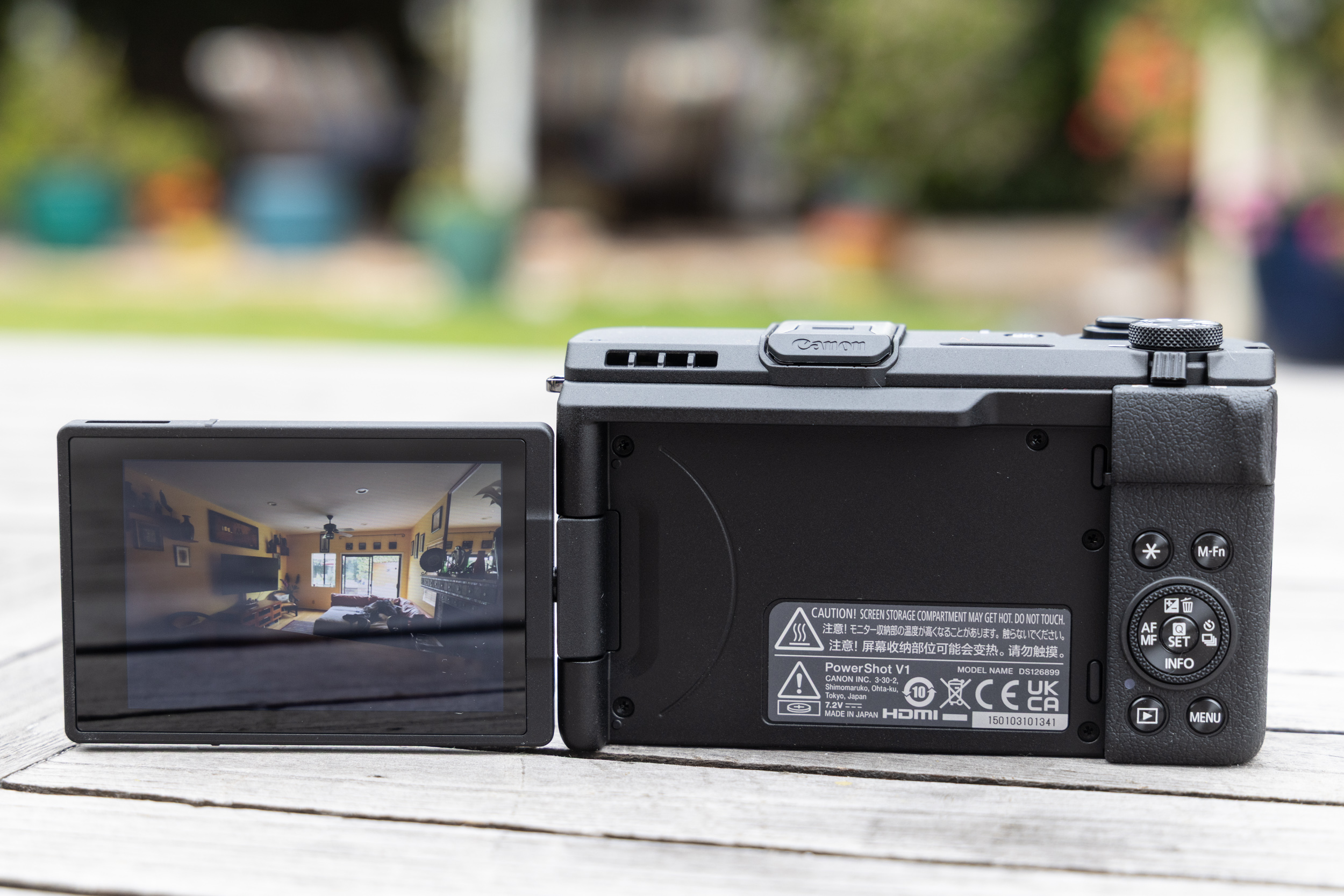
One other good change is a brand new totally articulating display, changing the earlier mannequin’s pop-up show. That makes vlogging and pictures simpler, as you may see the display when holding the digicam excessive, low or towards you. My solely criticism is that it’s a bit too dim when utilized in brilliant daylight. And you’ll’t simply look by the digital viewfinder to get a clearer view, as a result of there isn’t one on the PowerShot V1.
This digicam has first rate battery life for a compact at 400 pictures or about 75 minutes of 4K 30p taking pictures on a cost. Different notable options embody mic and headphone inputs together with a microHDMI and USB-C (charging and knowledge switch) ports, plus a single SD UHS-II card slot.
Vlogging and content material creation
The ‘V’ in PowerShot V1 stands for vlogging, so let’s discuss that subsequent. To finest serve in that capability, it makes use of a large 16-50mm equal lens so you may at all times suit your face into the body, even in cropped mode. Nonetheless, that zoom vary will also be limiting for capturing closeups or B-roll.
Video specs are top-notch for a compact, with sharp, supersampled 4K 30p video that makes use of the complete sensor width or 4K 60p video with a 1.4x crop. On high of that, you may seize 10-bit video when utilizing Canon’s C-Log 3 or HDR codecs.That’s higher than Sony’s ZV-1 II, which solely affords 4K 30p and S-Log video with no 10-bit possibility. Nonetheless, DJI’s Osmo Pocket 3 surpasses each fashions with uncropped 4K at as much as 120 fps, whereas additionally providing 10-bit D-LogM or HDR video.
With its giant sensor, the PowerShot V1 affords sharp video and correct, pure shade rendering with Canon’s typical excellence in pores and skin tones. Taking pictures in C-Log3 10-bit boosts dynamic vary significantly in sunny or contrasty scenes, whereas providing you with extra latitude to regulate video in put up. And when it’s essential to shoot indoors or at evening, the digicam outperforms compact rivals, displaying decrease noise at excessive ISO settings.
The drawback of a bigger sensor is that rolling shutter that may warp video is extra pronounced than on Sony’s 1-inch ZV-1 II on the 4K 30p setting. If that’s a priority, the cropped 4K 60p setting reduces the issue because it samples a smaller portion of the sensor.
Overheating isn’t a difficulty with this digicam both, due to the built-in fan. I by no means noticed any signal of a heat-related shutdown when utilizing the PowerShot V1 with the temperature threshold setting at “excessive.”
Autofocus is a vital characteristic for vlogging and the PowerShot V1 competes nicely towards Sony’s ZV-1 II, due to its upgraded processor. It stays locked even on fast-moving topics and the eye- and face-detection, together with topic detection for animals and autos, all work nicely.
The place the ZV-1 II solely affords digital video stabilization, the PowerShot V1 marries 5-stop optical stabilization with digital stabilization. Which means you may shoot clean handheld video with none impression on picture high quality, or allow e-stabilization for strolling or different difficult eventualities. Nonetheless, neither digicam holds a candle in that regard to DJI’s Osmo Pocket 3, which has a built-in 3-axis gimbal.
Audio can be a plus on the PowerShot V1, because it affords each mic and headphone jacks, whereas the ZV-1 II lacks a headphone port. Canon’s mannequin additionally has a good built-in stereo mic and comes with a hotshoe-attached wind muff.
Images
Regardless of the vlogging emphasis, the PowerShot V1 is very succesful for pictures as nicely. Actually, it excels in each picture high quality and velocity due to the distinctive 22.4MP, 1.4-inch sensor and Canon’s newest Digic X picture processor to energy autofocus and AI capabilities.
You possibly can hearth off bursts at as much as 30 fps in digital mode, and a really speedy 15 fps with the mechanical shutter (and sure, it has a mechanical shutter which is uncommon for a compact). That makes it one of many quickest compacts accessible. By comparability, the X100 VI can hit 25 fps speeds whereas the ZV-1 II is proscribed to fifteen fps speeds. The Osmo Pocket 3, in the meantime, can take pictures however is admittedly designed nearly solely for video.
The PowerShot V1’s excessive speeds are backed up by Canon’s Twin Pixel II focus system that delivers sharp pictures nearly all of the time, powered by the corporate’s newest AI tech for face- and eye-detection. As with different current fashions, the digicam additionally affords AI topic detection for animals, autos, airplanes and extra.
The PowerShot V1 trumps Sony’s ZV-1 II with its built-in 5-stop optical stabilization to cut back blur. That enabled me to take pictures right down to an eighth, and typically even 1 / 4 of a second, to blur backgrounds whereas maintaining the foreground sharp.
The difficulty with most compact cameras is that they’ll take good pictures in well-lit situations however begin to fall down in low mild. That’s not the case with the PowerShot V1. The bigger 1.4-inch sensor may be very shut in dimension to Micro 4 Thirds, so it delivers clear photographs as much as ISO 6400, with manageable noise whilst excessive as ISO 12800.
The fantastic thing about Canon cameras is that you just get great-looking photographs straight out of the digicam with no fuss, notably with pores and skin tones — a fantastic boon for rookies. JPEG photographs have a very good stability of sharpening and noise discount, whereas RAW pictures enhance dynamic vary in difficult taking pictures situations and provide you with extra room to mess around when modifying in Lightroom.
Wrap-up
I can see what Canon was going for with the $900 PowerShot V1. It successfully beats out its principal compact vlogging rival, Sony’s ZV-1 II, by providing a bigger sensor, optical stabilization and extra video choices for across the identical value. And it appeals to hybrid shooters greater than DJI’s Osmo Pocket 3 as it will possibly higher deal with pictures chores whereas additionally capturing higher-quality video.
The issue is that it’s nonetheless primarily a vlogging digicam and a variety of content material creators have deserted such a compact mannequin in favor of the Osmo Pocket 3. That’s as a result of the Pocket 3 affords distinctive options like motorized digicam monitoring and a superior three-axis gimbal. It additionally pairs with DJI’s fashionable Mic 2 and Mic mini wi-fi microphones, which is one other huge benefit. On the identical time, the PowerShot V1 has a fairly fundamental design, so it might not attraction to patrons searching for one thing prettier just like the X100 VI.
On the finish of the day, the PowerShot V1 is certain to be successful as a result of it delivers in relation to video and picture high quality — particularly given the present recognition of the now-ancient G7X III. Actually, I’d advocate it over Sony’s ZV-1 II, notably should you’re searching for a hybrid digicam that pulls double obligation.
This text initially appeared on Engadget at https://www.engadget.com/cameras/canon-powershot-v1-review-a-powerful-compact-camera-capable-of-capturing-incredible-video-163009584.html?src=rss
Trending Merchandise
