
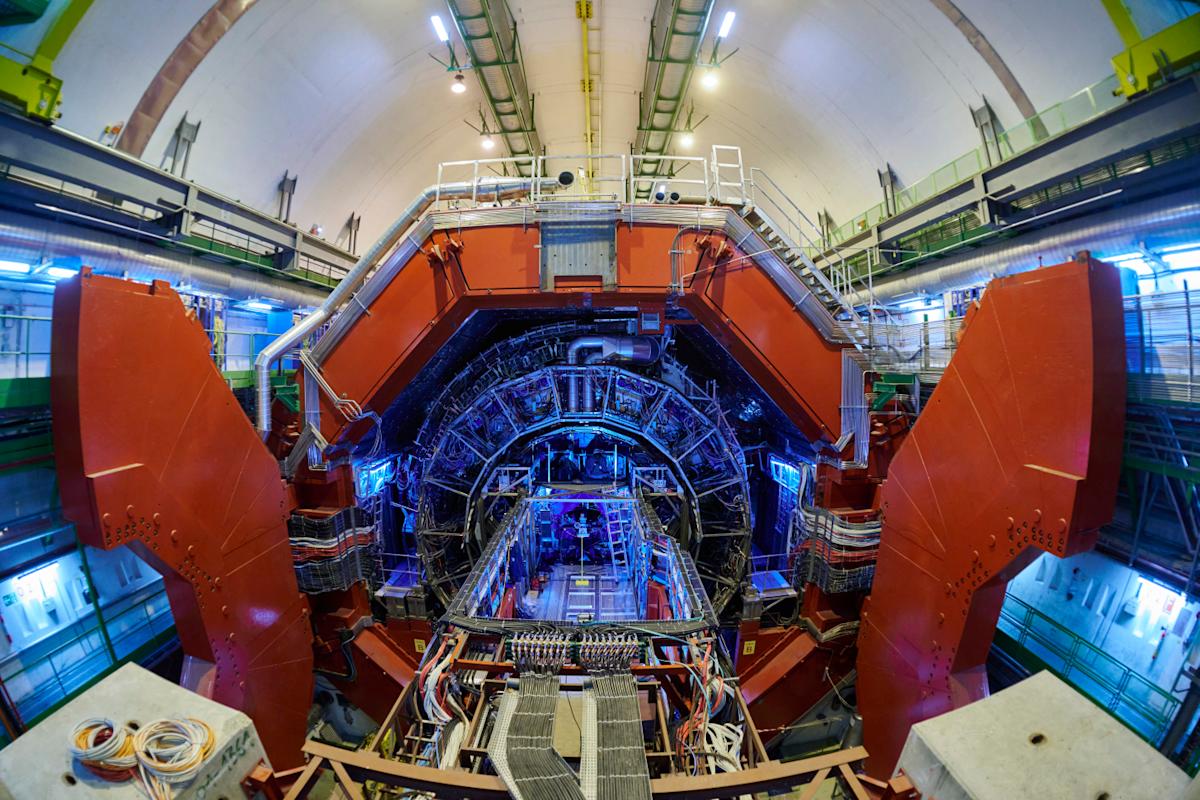
One of many final targets of medieval alchemy has been realized, however just for a fraction of a second. Scientists with the European Group for Nuclear Analysis, higher generally known as CERN, had been in a position to convert lead into gold utilizing the Massive Hadron Collider (LHC), the world’s strongest particle accelerator. Not like the examples of transmutation we see in popular culture, these experiments with the LHC contain smashing subatomic particles collectively at ridiculously excessive speeds to control lead’s bodily properties to change into gold.
The LHC is commonly used to smash lead ions collectively to create extraordinarily sizzling and dense matter much like what was noticed within the universe following the Large Bang. Whereas conducting this evaluation, the CERN scientists took notice of the near-misses that brought on a lead nucleus to drop its neutrons or protons. Lead atoms solely have three extra protons than gold atoms, which means that in sure circumstances the LHC causes the lead atoms to drop simply sufficient protons to change into a gold atom for a fraction of a second — earlier than instantly fragmenting right into a bunch of particles.
Alchemists again within the day could also be astonished by this achievement, however the experiments performed between 2015 and 2018 solely produced about 29 picograms of gold, in line with CERN. The group added that the newest trials produced nearly double that quantity due to common upgrades to the LHC, however the mass made remains to be trillions of occasions lower than what’s vital for a bit of jewellery. As a substitute of making an attempt to chase riches, the group’s scientists are extra fascinated by finding out the interplay that results in this transmutation.
“It’s spectacular to see that our detectors can deal with head-on collisions producing 1000’s of particles, whereas additionally being delicate to collisions the place just a few particles are produced at a time, enabling the research of electromagnetic ‘nuclear transmutation’ processes,” Marco Van Leeuwen, spokesperson for the A Massive Ion Collider Experiment mission on the LHC, stated in an announcement.
Trending Merchandise
