
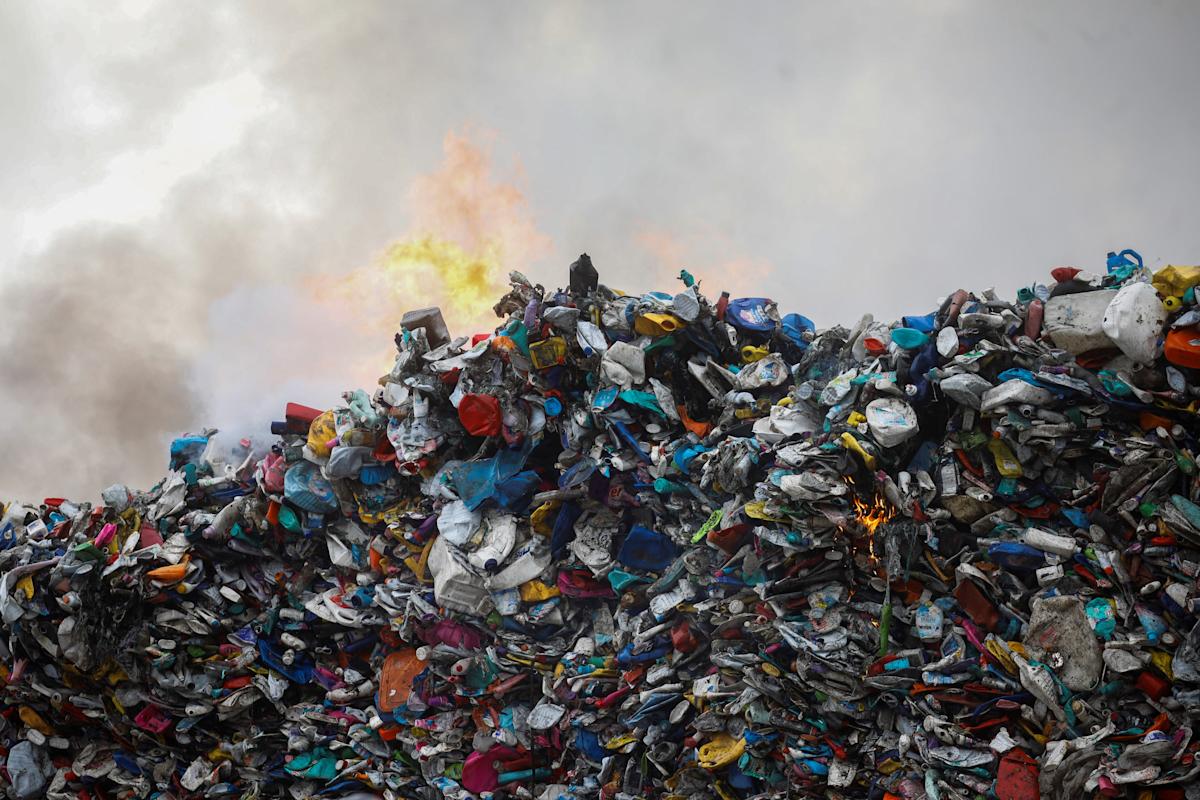
To sort out what’s been the plastic “epidemic,” the UN spun up a committee in 2022 tasked with brokering a legally binding international settlement. This formidable treaty between UN member states was to handle the total life cycle of plastics, from manufacturing to disposal: In brief, outline what counts as plastic air pollution and curb the kinds of unchecked manufacturing that inevitably results in it. However throughout 5 periods since, nations have failed to achieve a consensus on the textual content.
What was meant to be the ultimate session ended final 12 months in Busan, South Korea with out settlement, and representatives from 175 nations are actually set to satisfy once more for half two, this time in Geneva, Switzerland. INC-5.2 will happen from August 5 to 14, throughout which negotiators will try to see eye-to-eye on the factors of the draft treaty which have so far confirmed most contentious. In line with the (CIEL), there are over 370 such factors.
Scope
Manufacturing, the usage of chemical compounds of concern (these thought of to be a danger as a consequence of toxicity and/or different qualities), product design and the financing of treaty implementation are a number of the details of disagreement. These points have left nations in a impasse, in response to Cate Bonacini, Communications Supervisor for CIEL. There are nations that argue well being must be excluded from the treaty’s scope. These matters might be front-and-center going again into the talks, and UN member states have spent the final eight months “working arduous in closed-door conferences to seek out factors of settlement,” Bonacini stated in an e mail. “We’ll see the fruits of that labor quickly.”
“On the coronary heart of the problem,” Bonacini stated, “there’s a massive disagreement about what plastic air pollution is, and what measures are wanted to finish plastic air pollution.” Whereas the dedication focuses on the total life cycle of plastics, there’s been a lot dispute over the place that cycle actually begins.
“As scientists, we interpret the total life cycle as beginning with extraction and manufacturing,” stated Bethanie Carney Almroth, a professor of ecotoxicology on the College of Gothenburg and a member of the Scientists’ Coalition for an Efficient Plastics Treaty. “That might be fossil fuels and uncooked plastic manufacturing during to product, to make use of, to commerce, to transportation, to waste administration, mismanagement and environmental air pollution, together with remediation of current legacy plastics. All of it.”
Whereas over 100 nations final December have been in favor of a treaty that will impose manufacturing limits, others together with opposed the caps. Forward of that session, the US reportedly additionally made the choice , regardless of earlier indications that it will. Unsurprisingly, the nations which have taken challenge with the scope of the treaty are additionally a number of the world’s high oil producers.
“There are different actors,” Carney Almroth stated, “which can be attempting to slender that scope to go from plastic merchandise, like water bottles, to waste administration, so kind of excluding the outer boundaries of how we outline the plastics life cycle in order that it will, in essence, turn out to be extra of a waste administration treaty.”
Outdoors affect
Along with representatives from the collaborating member states, scientists, environmental organizations and business lobbyists are current for the negotiation periods. In line with Carney Almroth, who has attended each Intergovernmental Negotiating Committee (INC) assembly and is now in Geneva for INC-5.2, more and more it has been lobbyists who take up essentially the most area.
“On the final spherical of talks, lobbyists for the petrochemical and plastics industries made up the one largest delegation,” wrote Bangor College lecturer Winnie Courtene-Jones, who can be a member of the Coalition, in a current article for . CIEL discovered that “there have been 3 times extra fossil gas and chemical business lobbyists than scientists” on the Busan conferences. Bonacini famous that “plastics are 99 p.c fossil fuels, and these firms have a vested curiosity in persevering with to generate fossil fuel-based merchandise, together with plastics.”
Their affect has performed a giant position within the stalemate. They “have a number of energy, cash and affect,” Carney Almroth stated, “and their lobbying efforts transcend the partitions of the negotiating area…They’ve entry to choice makers in ways in which different observers don’t.”
“They do not wish to take a look at chemical compounds,” Carney Almroth stated. “They do not wish to take a look at manufacturing.” However that taking a look at chemical compounds (components, processing aids, and many others.) and manufacturing is of utmost significance, not solely within the context of environmental sustainability but additionally human well being.
In an editorial for the in July, a gaggle of scientists pointed to the quite a few potential well being results that current research have linked to plastics, by way of publicity to hazardous chemical compounds and from micro- and nanoplastics. That features an elevated danger of “a number of persistent ailments, together with most cancers, neurodevelopmental hurt and infertility” in addition to “respiratory, reproductive and gastrointestinal hurt, with potential hyperlinks to lung and colon most cancers.”
The authors known as on delegates to prioritize these considerations within the upcoming negotiations and work towards a treaty that will finish manufacturing of poisonous chemical compounds in plastics, ban the recycling of plastics containing these chemical compounds and scale back plastic manufacturing general. Their letter comes alongside a separate examine revealed this summer season within the journal that recognized over 4,200 chemical compounds of concern in plastics, out of the 16,325 whole . The researchers argue that, on high of building transparency across the make-up of plastics and eradicating chemical compounds of concern, plastics should be simplified if they’ll be made safer.
The numerous chemical compounds that go into plastics “may be launched all through the complete plastic life cycle, from feedstock extraction and manufacturing to make use of and waste,” the authors write. “Particular end-of-life therapies, equivalent to uncontrolled landfilling or incineration, can additional exacerbate chemical releases.” The has warned that the adverse results at each stage within the life cycle of plastics disproportionately hurt susceptible populations worldwide, together with indigenous peoples, low earnings households and rural communities.
The place issues stand
At present, plastic is kind of inescapable — microplastics may even be now. And analysis more and more suggests we aren’t absolutely conscious of how dangerous air pollution ranges actually are.
World plastic manufacturing has greater than doubled within the final 25 years, with upwards of now estimated to be produced yearly. Recycled plastics make up simply 6 p.c of that whole, a determine that is anticipated to remain the identical at the same time as international plastic use and waste era are projected to rise 70 p.c by 2040, in response to the worldwide Group for Financial Co-operation and Improvement (OECD). And every year, tens of thousands and thousands of tons of plastic waste is disposed of in methods thought of to be environmentally unsound, ending up in uncontrolled dumpsites, burned overtly or accumulating on land and in our bodies of water.
A revealed this summer season, led by researchers from Utrecht College and the Royal Netherlands Institute for Sea Analysis, discovered that there could also be much more plastic within the oceans than beforehand thought when accounting for particles even smaller than microplastics. The crew collected water samples from 12 places throughout the North Atlantic Ocean and measured the focus of nanoplastics (plastic particles below 1 micrometer) at completely different depths. By the researchers’ estimate, there could possibly be as a lot as 27 million metric tons of nanoplastic within the North Atlantic alone. That is within the ballpark of earlier international estimates for bigger plastic waste throughout all the ocean.
In one other new , researchers from France’s College of Toulouse discovered we could also be inhaling as much as 100 occasions extra microplastic particles indoors than earlier estimates, primarily based on measurements of airborne microplastics within the researchers’ personal flats and automobile cabins.
The state of affairs is pressing, particularly for susceptible populations, stated Carney Almroth. “The quantities of plastics we’re producing at this time and the quantity of plastic within the setting are astronomical,” stated Carney Almroth. As of some years in the past, “we had twice the mass of plastic on the planet because the mass of all of the animals on land, in water, together with bugs, and we’ve produced much more plastic since then.”
Plastics are “overwhelming any and all of our waste administration infrastructure, so we’re not in a position to forestall air pollution. We’re not in a position to mitigate hurt,” Carney Almroth stated. “The impacts of plastics within the setting are very massive scale, to the purpose the place they’re destabilizing important Earth capabilities like local weather, like nutrient biking, like biodiversity. After which we’ve the human well being impacts on high of that. It is an acute downside.”
The logistics of averting disaster
However, because the previous 5 periods have illustrated, reaching an settlement on easy methods to clear up that downside is not going to be simple. The difficulty, partly, boils all the way down to how the selections are being made. Thus far, it is all being completed by consensus slightly than voting, Carney Almroth and Bonacini defined. That strategy permits “a single nation veto energy over selections,” Bonacini stated.
Petrochemical nations together with Saudi Arabia, Russia, China, Iran, Kuwait, Qatar, India and Brazil have latched onto this, utilizing “obstructionist ways” to pull out the negotiations. Some have insisted “with out authorized foundation,” in response to CIEL, “that selections can solely be made by consensus.” Consensus, nonetheless, is not the one possibility.
The draft Guidelines of Process enable for majority voting within the occasion a consensus cannot be reached, however whether or not that may occur is but to be seen. “There are alternatives to power that rule,” Carney Almroth stated. However, a rustic (or nations) must step up and invoke it.
At this stage of the negotiations, there’s a danger that nations will compromise on key provisions for time’s sake, Bonacini stated, which might in the end weaken the treaty. And as soon as a treaty is finalized, “it may possibly take years, if not a long time, to make amendments to the unique textual content,” so getting it proper the primary time is essential. Worldwide agreements which have taken a softer strategy to addressing environmental points, just like the Paris Settlement — which lets nations set their very own targets for decreasing greenhouse fuel emissions — have been within the face of quickly rising international temperatures and local weather change.
In June on the UN Ocean Convention, representatives for 95 nations which can be a part of the INC reaffirmed their dedication to a treaty that addresses the total life cycle of plastics, phases out “essentially the most problematic plastic merchandise and chemical compounds of concern,” improves product design to cut back environmental and well being impacts and employs efficient technique of implementation. “A treaty that lacks these parts, solely depends on voluntary measures or doesn’t tackle the total lifecycle of plastics won’t be efficient to take care of the problem of plastic air pollution,” the group — which incorporates Canada, Australia, Colombia, Zimbabwe, the UK and Germany — wrote in . These nations added that “the treaty ought to present for the potential for decision-making, by way of common UN procedures if all efforts to achieve consensus have been exhausted.”
If an settlement is not reached this time round, there are a variety of the way the subsequent steps might play out. The talks could possibly be stretched even additional into one other assembly, or nations might determine to take the matter some place else.
“Many nations are contemplating alternate options if negotiations fail,” Christina Dixon, Ocean Marketing campaign Lead for the Environmental Investigation Company advised . “Choices embrace returning to the United Nations Setting Meeting (UNEA) to determine a brand new increasing mandate, making a conference exterior the UN for dedicated nations to maneuver ahead or adopting a protocol below an current conference.” The UNEA meets subsequent in December.
We’re, as Courtene-Jones wrote in The Dialog, at “a crucial crossroads.” That is one thing advocates for a robust, science-based treaty all appear to agree on. “There are a number of locations the place we will actually do so much to make a distinction, and make issues higher,” stated Carney Almroth. “International locations must be formidable, and want to face up and demand this.”
Trending Merchandise
